

New Evidence Solves the Mystery
At a Glance
- New evidence may solve the mystery of HMS Beagle’s final fate
- Research links the ship to London shipbreakers Murray and Trainer
- Records suggest Beagle was likely taken to the River Thames
- The Paglesham mud dock remains a Scheduled Monument
- Essex Coastguard families remain part of Beagle’s local history
An Essex maritime researcher, who describes himself as an “enthusiastic amateur”, believes he has solved the long-standing mystery surrounding HMS Beagle (235 tons), Charles Darwin’s former ship, following its 25 years as a static Coastguard vessel in Paglesham, Essex.
Mike Salter from Chelmsford first discovered that the Beagle had been stationed in the Essex marshes when reading about a riverside walk that identified the location of the ship’s final berth. Although the site was in roughly the right area, he realised the position was incorrect.
After reading many articles, survey reports, books and academic papers on the subject, including work by Paglesham resident Ann Boulter, Salter became intrigued to find out if there was any truth in claims that parts of the Beagle might still lie in the mud of the dock.
The Beagle was sold by the Navy at an auction in London in May 1870 to purchasers Murray and Trainer. Little is recorded after this until 2002/3, when Dr Prescott of the University of St Andrews and Dr Pillinger (of Beagle space probe fame) conducted a remote sensing survey at the mud dock site.
Dr Prescott and the team used ground-penetrating radar to examine the site without excavation. The scans revealed the outline of a dock, along with traces of wood and metal, suggesting something substantial lies buried there, possibly linked to Beagle. Although no remains were found within it, the mud dock itself was designated a Scheduled Monument by Historic England in 2020, following a comprehensive survey by Wessex Archaeology.
Survey Plans Rejected
More than 20 years after the initial survey, Salter decided to appoint the firm used by the University of St Andrews to undertake a new investigation to determine whether substantial remains exist within the dock. However, the application to Historic England was not approved. Core sampling was not permitted and the radar technology was considered unsuitable for this location due to clay subsoils and high salinity levels, with concerns that the technique would not have penetrated to the required depth.

Boulter acknowledged that the Prescott survey may have identified remains. However, after further radar, surveys, core samples, dendrochronology analysis and diatom testing (single-celled algae used to identify exposure to Southern Ocean conditions), she now concludes that there are no significant remains at the site.
Continuing his research, Salter discovered new evidence at the National Archives in Kew in 2025, which showed that Murray and Trainer had also purchased a second Navy ship, Advice, at the May 1870 auction. Further investigation of newspaper archives uncovered a previously overlooked advertisement placed by a London shipbroker just a week after the auction, inviting the towing of ex-Navy ships, one from Devonport and a hulk from Paglesham, to the River Thames.
Ships Identified In Records
Although the ships were not named in the advertisement, they can be identified as the Advice and the Beagle. The editor of Mariner’s Mirror, which published a note on these findings in November 2025, highlighted a report in the Kentish Mercury from February 1871. This reported that Murray and Trainer were prosecuted by the Thames Conservancy for causing pollution of the River Thames while breaking up a 600-ton iron-hulled ship at their East Greenwich location.

The evidence suggests that, in total, they purchased three ships in 1870 and were established shipbreakers operating in London, rather than Essex locals with similar names who allegedly dismantled the Beagle in its dock, leaving the lower hull to sink in the mud, as Dr Prescott had proposed.
Further confirmation comes from the Thames Conservancy Board minutes, which record both the prosecution and the address of Murray and Trainer as Crawley’s Wharf, East Greenwich. They were ultimately acquitted on the evidence of the Conservancy’s Port of London harbourmaster.
In 1846, the Beagle’s last Captain, John Lort Stokes, believed that she would end up on the mudflats of the Thames estuary. A similar view was later expressed by K. S. Thompson (American Scientist, 1975), reflecting the fate of many famous Navy ships.
Beagle’s Quiet Final Years
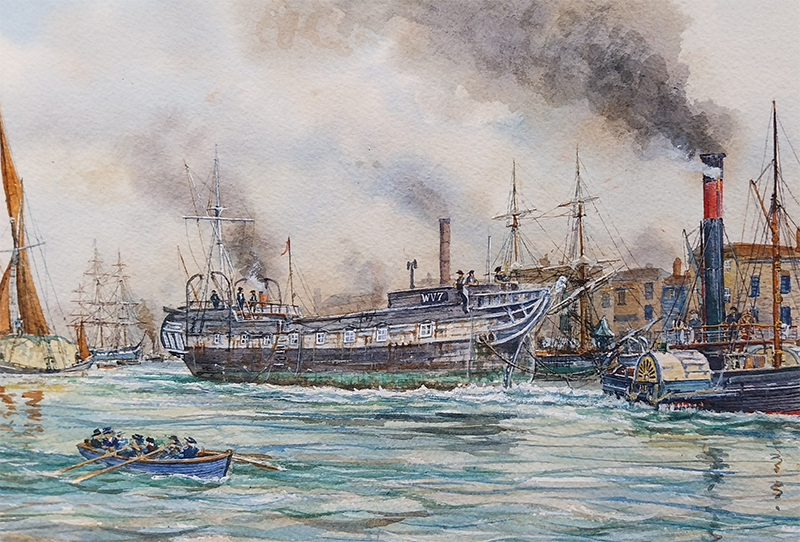
Other writers suggested that Beagle became a collier, was converted into a barge or was sold to Japan (a confusion with a later steamboat). Instead, she returned close to Woolwich where she was built in 1820. Unlike The Fighting Temeraire, which depicts HMS Temeraire being towed up the Thames after its service at the Battle of Trafalgar, Beagle appears to have ended service without public attention.
Beyond the dock itself, there may still be living relatives of the Coastguard families connected to Beagle. Between 1845 and 1870, 20 children from these families – Prow, Drake, Gray, Prideaux, Grigg, Bristow, Newman, Staines, Cooper, Thomas, Atkins, Harcom, Haill and Wallace – were baptised at St Peter’s Church. A living reminder of the ship’s presence in Essex.