

At a Glance
- Concerns raised over missing and incomplete Councillor Declaration of Interest Forms
- Comparison with Rochford District and Castle Point Councils
- Legal duties under the Localism Act 2011 highlighted
- Questions raised about transparency, accountability, and charitable declarations
IRefer to the fact that Southend Council seem to be lax when it comes to deterring potential Councillor corruption, compared to their neighbours at Rochford District Council and Castle Point Council.
I came to this conclusion after noticing on our Council’s public website that some of our 51 elected Councillor’s ‘Declaration of Interest Forms’ were missing and many of those displayed on the website showed that some Councillors had not answered some of the mandatory questions and left them blank.
This is not the first time I have had to remind our Council of their legal duty to ensure that such documentation is complete and available to the public on their website. i.e. In 2016, I raised this subject via my local Councillor and in 2023, I addressed my concerns directly to the Council’s Chief Executive Officer which seemed to fall on deaf ears, as it coincided with him suddenly resigning on Non-Disclosure Agreement (NDA) terms, without there being any public explanation for his departure.
The law (Localism Act 2011) requires elected Councillors to declare within 28 days of them being elected their pecuniary and non-pecuniary interests and act as a deterrent to them from committing any corrupt activities within the Council’s business.
Section 29 of the Localism Act 2011 requires the Council’s Monitoring Officer to establish and maintain a register of interests of members of the authority.
When after four months I had not received a response from our Council regarding my recent concerns about this subject, I referred to our Council’s Constitutional Document, which sets out how our Council operates, how decisions are made and procedures which are followed to ensure that these are efficient, transparent and accountable to local people.
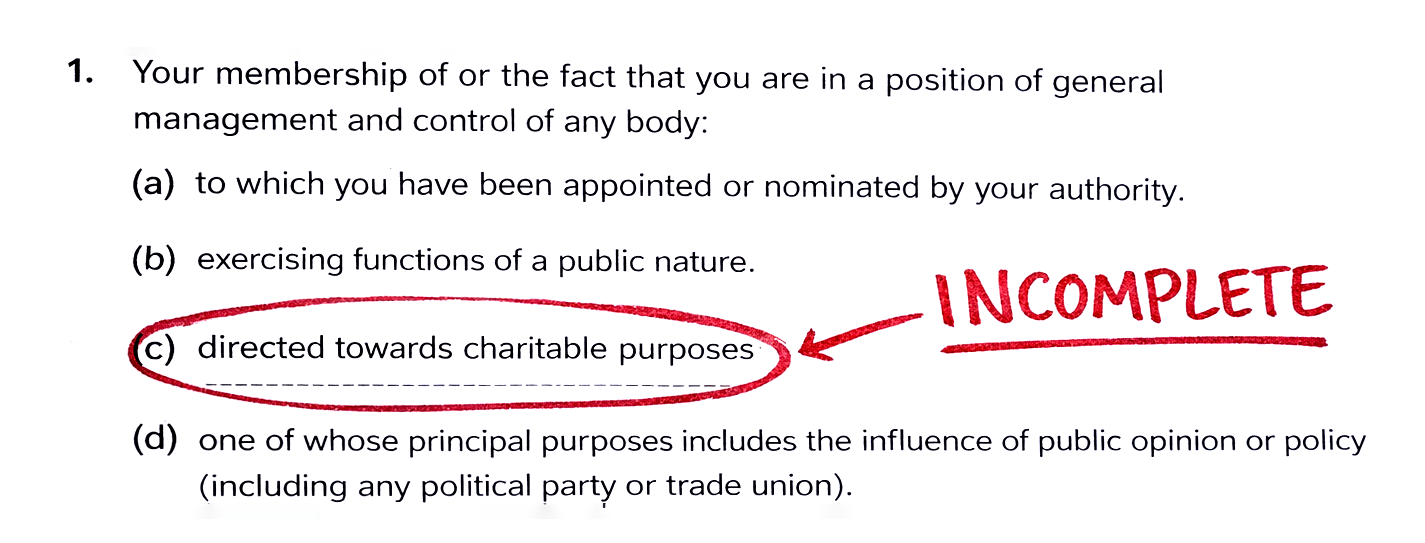
It was at this stage of my research when I noticed the Constitutional Document clearly defined what information Councillors were expected to register when declaring their interests. Reference: The Code of Conduct for Councillors, Table 2, Other Registerable Interests.
Char itable Declarations Removed
However, the mandatory requirement to register any involvement with organisations directed to charitable purposes was not being reflected in the recently revised Councillor Declaration of Interest Forms, which are being displayed on the Council’s public website.
I subsequently raised this issue with our Council by asking them if this meant that Councillors who belonged to organisations like freemasonry should declare their interests and received the following reply:
‘It is the personal responsibility of each elected Councillor to register any interests they may have in compliance with the Code of Conduct for Councillors. The Monitoring Officer may advise Councillors but any decision rests with the Councillors themselves.’
I did not believe this response clearly answered my question, especially as the current Councillor Declaration of Interest Forms do not draw Councillor’s attention to the fact that they are required to register any involvement they have with any organisations directed to charitable purposes.
Neighbours Set Higher Standards
Further research has highlighted that our neighbouring councils Rochford District and Castle Point do require their Councillors to register any interests they have with organisations directed to charitable purposes.
On checking their websites, I found their Councillors appeared to be open about their interests, from giving answers that they were members of freemasonry to belonging to scout associations.
What I don’t understand is why Southend Council for years have been so lax, when it comes to their Councillor anti-corruption procedures compared to their neighbouring councils, whose procedures are far more robust and designed to demonstrate a Councillor’s openness and transparency when conducting their council duties.
Transparency Prevents Future Conflicts
If in the future we have another example of a Councillor accusing a fellow Councillor of representing a housing developer, rather than his residents, as in 2016, over planning consent on a Shoeburyness flood plain. It is important that Councillor’s personal interests are clearly defined when such accusations are being made.
The last thing we want is our Council’s business decisions to be unfairly influenced by an unelected third party.
Legal Loopholes Undermine Accountability
Unfortunately, our previous Government’s decision to abolish the Standards Board and replace it with the flawed Localism Act 2011, now gives Councillors a potential legal ‘get out’ clause, if they plan to commit an offence and risk not being detected for three years after committing an offence.
This could be a temptation when multi-million-pound council contracts and planning consents are at stake. The Localism Act 2011, Chapter 7, Section 34, Offences (7) refers.
This potential legal ‘get out’ clause needs to be removed by Central Government action, hopefully, supported by our two local MPs.
These changes are required if we are to protect the reputations of the majority of our local Councillors and Council officers, who are trying to do a good job and up hold our democratic values.
By Dave Lee
Local Resident